Benjamin Franklin, one of the senior founders of the USA, had some thoughts in 1745 about older women which he expressed in a letter to a friend apparently seeking advice: “… in all your Amours you should prefer old Women to young ones. You call this a Paradox, and demand my Reasons. They are these…” (http://www.leatherarchives.org/exhibits/franklin.htm). Franklin goes on to list eight reasons and apparently this monologue has been reduced to speaking points on barroom walls where cougars troll for younger guys (See this URL for further details: http://thelipstickchronicles.typepad.com/the_lipstick_chronicles/2009/04/ben-franklin-ruined-my-life-as-a-cougar.html).

Serious discussion about sexual activity among elders is often masked in humor or silence, yet it is widely assumed that humans are sexual beings all of their lives. So, what do we really know.

A comprehensive study of sexual behaviors among seniors was reported in 2007. The authors begin, “Little is known about sexuality among older persons in the United States, despite the aging of the population.” and conclude “Our findings, based on nationally representative data from the NSHAP, indicate that the majority of older adults are engaged in spousal or other intimate relationships and regard sexuality as an important part of life. The prevalence of sexual activity declines with age, yet a substantial number of men and women engage in vaginal intercourse, oral sex, and masturbation even in the eighth and ninth decades of life.” (Lindau, 2007)

A recent study (Trompeter, 2012) found that “Not only were the oldest women in this study the most satisfied overall, those who were recently sexually active experienced orgasm satisfaction rates similar to the youngest participants. ‘In this study, sexual activity was not always necessary for sexual satisfaction. Those who were not sexually active may have achieved sexual satisfaction through touching, caressing, or other intimacies developed over the course of a long relationship,’ says first author Susan Trompeter… ” (http://seniorjournal.com/NEWS/Sex/2012/20120103-SexualSatisfaction.htm).

One tricky aspect of sexuality as one ages is the specter of dementia and even Alzheimer’s Disease. Where does sexuality go when the mind does? Or does one just not remember last night? The latter might not be so bad as one remembers some youthful and particularly busy New Years’ Eves and the desperate desire to forget but the cruel fate of functioning brain cells.

Regardless, the loss of cognitive function does raise serious concerns about consent and not taking advantage of an older person who is not fully aware of what’s going on. The Alzheimer’s Society has an insightful factsheet on this aspect of sexual life: http://www.alzheimers.org.uk/site/scripts/documents_info.php?documentID=129

References

Lindau, ST, et al. A national study of sexuality and health among older adults in the U.S. New England Journal of Medicine, 2007, 357, 1, 762-774 (http://www.nejm.org/doi/full/10.1056/NEJMoa067423).

Trompeter, SE, Bettencourt, R, & Barrett-Connor, E. Sexual activity and satisfaction in healthy community-dwelling older women. American Journal of Medicine, Jan 2012, 125, 1, 37-43 (http://www.amjmed.com/article/S0002-9343(11)00655-3/abstract).

Image source: http://www.hotelchatter.com/files/6193/Cougars.jpg


A film about Margaret Thatcher, Iron Lady (http://www.imdb.com/title/tt1007029), has recently been released and what follows is an excerpt from a review I read in today’s Austin American Statesman.

“Though little has been written in the press about Thatcher over the past 10 years, she has been suffering from the deteriorating effects of dementia. … The most affecting part of the movie comes from the examination of what happens when a former world leader is reduced to being just another old person suffering the effects of aging. Seeing Thatcher, a woman comprised of such fierce fire and intimidating ice, in declining health reminds us that time is eventually unkind to us all. But why are we forced to view this part of the woman’s life without examining what made her great and flawed? The movie feels mean while at the same time trying to make the audience feel sympathy.” (Odam)

In case you missed the 1980’s, Margaret Thatcher “served as Prime Minister of the United Kingdom from 1979 to 1990. During her time as prime minister, Thatcher’s strict conservative policies, hard line against trade unions and tough rhetoric in opposition to the Soviet Union earned her the nickname the Iron Lady.” (http://en.wikipedia.org/wiki/Margaret_Thatcher)

And others have expressed similar views.

“… You can’t help wondering, why do we have to have this film right now. It is a film much more about ageing and elements of dementia rather about than an amazing prime minister,” David Cameron, current UK Prime Minister recently told BBC Radio 4.

One-time Thatcher rival, Michael Heseltine, took a similar view, “I think Mrs. Thatcher was a formidable prime minister and to produce a film in her later stages of life depicting the problems of advanced old age, I find extremely distasteful,” he told Britain’s Daily Telegraph newspaper. (http://today.msnbc.msn.com/id/45898042/ns/today-entertainment)

What’s the point here? Well I was reminded of the sculpture by Auguste Rodin, Celle Qui Fut La Belle Heaulmiere (She Who Was the Helmet-Maker’s Beautiful Wife). I discussed this art work in It’s Curious back in November. It’s a statue of an old woman and it makes us ponder the wonderful life she has had. I think this film, Iron Lady, makes us consider the whole person too, not just the powerful politician or female role model. So, it is again curious that people find such a vantage point to be distasteful or mean.

References and Resources

Odam, M. Streep can’t save Iron Lady. Austin American Statesman, 1-13-12. http://events.austin360.com/reviews/show/14122404-review-the-iron-lady

Picture from – http://upload.wikimedia.org/wikipedia/commons/f/f6/Margaret_Thatcher_cropped1.png

The cracks in time are getting wider.

Just before a heroic task, Valeria says to Conan, “Do you want to live forever?”

Valeria in Conan the Barbarian

In the midst of the battle of Belleau Wood, June 6, 1918, Sergeant Major Dan Daly admonished his cowering troops, “Come on, you sons of bitches, do you want to live forever?” (Rosofsky)

Well, my Mayan calendar developed a number of cracks over the holidays and steam is issuing forth from them but we are still here. Oh, right, the world does not end until December 21, 2012. So, we have an opportunity to reflect on the time we have left.

What are our expectations for life? Do we fear dying? Do we want to live forever?

Well, here is one viewpoint. “Aubrey de Grey, British researcher on aging, claims he has drawn a roadmap to defeat biological aging. He provocatively proposes that the first human beings who will live to 1,000 years old have already been born. … de Grey challenges the most basic assumption underlying the human condition — that aging is inevitable. He argues instead that aging is a disease — one that can be cured if it’s approached as ‘an engineering problem.'” (TED)

“He has ‘seven deadly things’ that erode the body’s youthfulness at the cellular level, eventually leading to death by old age.

  1. Cell death and atrophy: Treatable with exercise, stem cells, and chemicals which stimulate cell division.
  2. Cancerous cells: Theoretically treatable with a type of gene therapy being developed, called Whole-body Interdiction of Lengthening of Telomeres (WILT).
  3. Mutant mitochondria: Mutated DNA in the mitochondria causes a number of diseases. These can be prevented by moving the mitochondrial DNA into the cell nucleus, where the rest of the DNA resides.
  4. Cell senescence (unwanted cells): Fat cells and other unwanted cruft can be removed surgically, or by stimulating the immune system to attack unwanted cells.
  5. Extracellular crosslinks (loss of elasticity): Certain proteins, such as those in cells making up the arteries, become too rigid over time because they bond to each other. These bonds can be broken with certain chemicals (some in clinical trials even today).
  6. Extracellular junk: ‘Plaque’ which collects between cells can be eliminated by stimulating the immune system, and/or by using peptides called ‘beta-breakers.’
  7. Intracellular junk: Molecular garbage can be prevented from overwhelming certain cells by introducing enzymes which are known to be effective against such molecules.” (Bellows)

The ideas presented by de Grey are controversial and unproven however they have generated lively discussion and “… we might charitably say that de Grey’s proposals exist in a kind of antechamber of science, where they wait (possibly in vain) for independent verification.” (Pontin)

There are tricky aspects to living longer. When you change one thing something else is also affected. Aging researcher, Steven Austad says, “The longest-lived mice are dwarf mice that live 75 percent longer when given a calorie-restricted diet in a controlled environment. If you put those same mice out in the fields around my building, they wouldn’t last a day. In laboratory conditions, they live longer, but in the real world, they wouldn’t stand a chance. All the life extending genes investigated in detail have turned out to manifest side effects. As we move toward the development of interventions in the aging process in the not-too-distant future, we must not forget this.” (Rosofsky)

Rosofsky goes on to say, “All this reminds me of Isaac Asimov’s The Naked Sun in which we enter Solaria, a society where humans live for centuries. But they are so paranoically self-protective they are all recluses surrounded only by subservient robots. The idea of ‘seeing’ someone in the flesh rather than simply ‘viewing’ them on a video screen fills them with dread. They are quite unable to survive contact with others outside of their protective cocoons.”

Ah well. Perhaps living forever won’t work out. Still, would we want to live forever? Maybe we don’t get a choice? That Mayan calendar seems to be puffing black smoke now and there is a faint glow in the cracks.

References and Resources

Bellows, A. Do You Want to Live Forever? Damn Interesting Blog, October 2005. http://www.damninteresting.com/do-you-want-to-live-forever/

Conan the Barbarian, Universal Pictures, 1982. http://www.imdb.com/title/tt0082198/

Pontin, J. Is Defeating Aging Only a Dream? Technology Review, July 2006. http://www.technologyreview.com/sens/index.aspx

Rosofsky, I. Adventures in Old Age: Do You Want To Live Forever? Psychology Today, 1-28-2009 http://www.psychologytoday.com/blog/adventures-in-old-age/200901/do-you-want-live-forever

TED Speakers – Aubrey de Grey: Seeker of Immortality. TED, Octover 2006. http://www.ted.com/speakers/aubrey_de_grey.html

Holidays bring extended time with family. That is expected to be a good thing, but it can be stressful. It may be particularly stressful if you have relatives or friends with Alzheimer’s disease. I found a few interesting resources from caregivers to help you hold your emphasis on love during the holidays.
These two blogs had a few simple helps.

After it’s all over, the surviving spouse needs to thoughtfully re-engage. The steps of one survivor are chronicled here. Barton, W. L. Our Journey Through Alzheimer’s – Christmas Preparations. December 3, 2011. http://ourjourneythroughalzheimers.blogspot.com/2011/12/christmas-preparations.html

This is a short entry as too many ideas get lost in the rush.

Bask in moments of mindfulness and reflection during the last few weeks of 2011. 2012 is coming soon and my Mayan calendar is warm to the touch and beginning to vibrate. One wonders what the new year will bring?

Alzheimer’s disease is the dark cloud on the horizon and it has no silver lining. There is no cure for Alzheimer’s disease and no way of preventing it. Well, that’s true for now and it may not always be so.  Twenty-five years ago there were no cures for AIDS, still are no cures, but people with AIDS can lead long and productive lives with the aid of current medical therapies. Perhaps Alzheimer’s disease will suffer a similar fate and we will either find a cure or a way to reduce it’s effects so that I can still write this column and make films.

Cheshire Cat

Some new insights are coming along for treating Alzheimer’s disease by looking at gene mutations or simply patterns of genes. For example, some forms of lung cancer will respond to a specific drug if the patient has a particular mutation (Gardner). Also, a screening test called Oncotype Dx can help decide against radiation therapy in addition to surgery for women diagnosed with a form of breast cancer, ductal carcinoma in situ (Park). This also carries over into Alzheimer’s disease. Recent work appears to show that an abnormal protein, beta amyloid, could be a marker for future development of Alzheimer’s disease (Lazar)

Citing this work, Sperling, Jack & Aisen content that we need to learn how to identify people before the onset of symptoms and begin treatments. They wish to study the effect of drugs that lower this particular protein in people with the abnormality to see if Alzheimer’s disease can be prevented. Further, they assert that studying people with Alzheimer’s disease is too late to really do any good. They state, “Converging evidence suggests that the pathophysiological process of AD begins many years before the onset of dementia. So why do we keep testing drugs aimed at the initial stages of the disease process in patients at the end-stage of the illness?”

It’s a problem that needs to be treated before it appears. An interesting problem. Sort of like Schrödinger’s cat (en.wikipedia.org/wiki/Schrödinger’s_cat).

——————————————————————

References

Gardner, A. Gene mutation improves response to lung cancer, US News, 8-19-2009. http://health.usnews.com/health-news/family-health/cancer/articles/2009/08/19/gene-mutation-improves-response-to-lung-cancer-drug.

Lazar, K. Alzheimer’s study probes drug to cut brain protein, Austin American Statesman, 12-2-2011, p. A25.

Park, A. Decoding breast cancer, Time, 12-19-2011, p. 26.

Sperling, RA, Jack, CR & Aisen, PS. Testing the Right Target and Right Drug at the Right Stage, Science Translational Medicine, 2011, 3(111), p. 111cm33.

Image: The cheshire cat in Lewis Carroll’s Alice in Wonderland drawn by John Tenniel (1820-1914) in the 1866 edition. In the public domain.

Total U.S. population grew 9.7% between 2000 and 2010. In the same period Texas grew by 20.6%. The senior population growth (65 and older) in that period, U.S. vs. Texas was 15.0% vs. 25.5%. So, while Texas is growing faster than the U.S. average, the senior population is growing ever faster. So what does that mean other than providing work for those of us interested in aging? Well, it can mean a lot of things, most of them highly subjective and speculative.

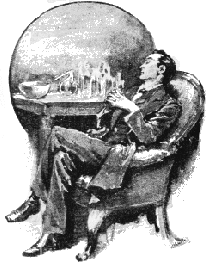
Sherlock Holmes
Sherlock Holmes

To me it means we must stop separating people into categories. Categories lead to stereotyping and that leads to assumptions about behavior and assumptions are always wrong. Miguel Ruiz says, “Don’t make assumptions.” And in his book The Four Agreements proceeds to tell us why we are always wrong when we do.

Now that all the demographers and epidemiologists are sputtering about the accuracy of their predictions about human behavior, let me quote from my bard, Sherlock Holmes, “… while the individual man is an insoluble puzzle, in the aggregate he becomes a mathematical certainty. You can, for example, never foretell what any one man will do, but you can say with precision what an average number will be up to. Individuals vary, but percentages remain constant. So says the statistician.” And so says I, about 6.5% of Texas’ 40.3 million people are over 65 (it’s smaller as a total size compared to the increase, but I digress) but when meeting any individual it’s unwise to assume anything about them.

An example from voting behavior policy. Palmore, Branch & Harris say the Senior Power Model assumes that older people vote cohesively, as a block on common issues. This is not the case, their voting decisions are as diverse as the general population. Another assumption of this model is that older people have a common stake and opinions about government sponsored old-age benefits and will vote accordingly. This too is not the case.

When we look at the beach, often all we see is sand, spreading and flowing down into the sea. If we squat down and pick up a grain of sand, we discover it is unique and probably has a story to tell of oceans and waves across millennia.

——————————————————–

As an aside – Maria Konnikova writes a guest blog for Scientific American dealing with the lessons we can learn from Sherlock Holmes. She has not dealt with my particular quote but many of the entries discuss how we gather data and draw erroneous conclusions from it.

——————————————————–

References

Castillo, J. Central Texas at forefront of U.S. boom in older citizens, Austin American Statesman, Thursday, December 1, 2011, p. 1,8.

Doyle, A. The Sign of Four. In the Complete Sherlock Holmes, Doubleday & Co., N.Y., 1930, p. 148.

Konnikova, M. Lessons from Sherlock Holmes. Blog series from Scientific American. Latest entry: http://blogs.scientificamerican.com/guest-blog/2011/11/15/lessons-from-sherlock-holmes-dont-try-to-make-bricks-without-clay/

Palmore, EB, Branch, LG & Harris, DK. Encyclopedia of Ageism. Google Books, 2005, p. 251. http://books.google.com/books?id=UoD4M0RGAvUC

Ruiz, M. The Four Agreements. Amber-Allen Publishing, San Rafael, CA, 1997.

Illustration by Sidney Paget (1860 – 1908) (Strand Magazine) [Public domain]

Today is Black Friday. The day American businesses hope to get out of the red and into the black. I’ve always though they could have picked a happier and less obscure name for the day. Like perhaps, “Total Consumerism Day” or maybe “Make Santa Happy Day” or “Buy My Stuff Day.” How do rural communities and the elderly fare on this day of shopping frenzy?

Black Friday Shopping

In smaller rural communities so many economic functions have been lost that alternatives and variety in shopping are very limited and shoppers need to travel to larger communities to shop. Also, congestion on both the roads and at stores is mentioned by elders as a concern when going shopping. For elders with transportation limitations there are programs offered under the Older Americans Act that provide rides for essential trips, such as medical appointments, business errands, shopping and senior activities, with door-to-door transportation often available (http://www.raconline.org/info_guides/aging/agingfaq.php). Finally, many elders cite going shopping as a social activity and find interactions with friends they run into and store personnel to be pleasant activities (Curch & Thomas). So, while rural communities often are not a shoppers paradise; going shopping can be done by older individuals.

Not many older people go shopping on Black Friday. A recent survey indicated that 10.5% of shoppers 65 and older will participate in Black Friday weekend shopping (Consumer Intentions & Actions® Survey, November 11, 2011, National Retail Federation, http://www.nrf.com/modules.php?name=News&op=viewlive&sp_id=1251).

Considering the benefits and limitations of “Going Christmas Shopping” to what degree are older persons sidestepping the whole issue and shopping on-line instead?

In general, online shopping has been growing and it’s pretty obvious that for those of us at the end of a rural delivery route that getting stuff by mail or FedEx is a whole lot easier than driving 40 miles to the nearest major mall. Even Christmas has it’s online alternative to Black Friday. It’s called Cyber Monday and it is growing as an option to fighting the crowds. “ComScore, a digital marketplace research firm, expects online sales for the 2010 holiday season will reach $32.4 billion, marking an 11% increase over the previous year for the combined November-December gift-buying period”  (http://money.cnn.com/2010/11/26/news/economy/cyber_monday_next/index.htm).

So on-line use has been growing and what is the impact on the elderly? According to a survey by Jones and Fox, “the biggest increase in Internet use since 2005 can be seen in the 70-75 year-old age group. While just over one-fourth (26%) of 70-75 year olds were online in 2005, 45% of that age group is currently online.” Jones and Fox do not discuss online shopping and I could not find specific figures for either elderly or rural populations. In conclusion, the data are incomplete on my question of the degree of geriatric online Christmas shopping. I’ll have to look into it more, but as it’s Black Friday and the day is slipping away, I need to get a few more things online.

References

Curch,LM & Thomas, AR. Shopper s Paradise Lost: Shopping by Elderly Adults in the Age of Big Box Businesses. Center for Social Science Research, State University of New York, College at Oneonta, 2006, http://www.oneonta.edu/academics/ssr/PDF/Elderly%20Shopping.pdf

Jones, S & Fox, S. Generations Online in 2009, Pew Internet and American Life Project, 2009. http://www.pewinternet.org/~/media//Files/Reports/2009/PIP_Generations_2009.pdf

Rodin’s La Belle Heaulmiere

Rodin’s La Belle Heaulmiere

It’s very curious how little we change throughout our lives.

Further, it’s more curious how we stereotype people into groups. We have Democrats and Republicans, heterosexuals and homosexuals, young and old, etcetera and etcetera. Especially curious are generation labels; the greatest generation, the silent generation, the baby boomers, generation X and millennials. Each group has characteristics and we tend to expect people classified into a particular group to behave as if they were following the stereotypical playbook of their group.

Back to my first statement; we change little during the course of our lives. Is that true? Does not growing up, going to school, serving in the military, getting married, raising kids, having careers, retiring, etcetera cause us to change? I think not. Theses are all experiences and they become part of our experience base, but truly we are the same our whole lives.

I was reminded of this yesterday. When I was in the Air Force 43 years ago, my wife and I were friends with another couple. Over the years we remained friends with half of that couple and she arrived yesterday for a visit. It’s been awhile since my wife last visited her in Ohio and I had not seen her in maybe 15 years. She walked up to me at the airport, spoke, and for a long second I did not recognize her. We change physically. Then it clicked and my friend of 43 years ago was standing there. Later, we shared the observation that our lives evolve and our bodies change but our perception of ourselves remains the same. In our minds, we are constant.

We are also unique. Society puts my friend, my wife and I generally into the baby boomer group but none of us fit a stereotype. This is the danger of groups, especially for health care providers who serve groups of people. There is a danger to begin to think about members of our service group as fitting a particular mold and pattern.

I think this stereotyped thinking is most prevalent among those working with the elderly. Older people tend to stand out due to their appearance and often to obvious loss of physical agility and perhaps mental acuteness. Also, older people usually do not fit our most prevalent stereotype that of the beautiful person who as a female is young, slim, graceful or the male who is tall, young, dashing. Thus, older people get stereotyped from first glance and that leads to a failure to fully appreciate the unique and fascinating human who lives inside. In the novel, Stranger in a Strange Land, Robert Heinlein describes a sculpture by Auguste Rodin, Celle Qui Fut La Belle Heaulmiere (She Who Was the Helmet-Maker’s Beautiful Wife) that on the surface reinforces our shortsightedness but with mindfulness increases our potential to see farther.

“What do you think of this bronze?” asked Jubal.

Anne looked at Rodin’s masterpiece, and said slowly, “When I first saw it, I thought it was horrible. But I have come to the conclusion that it may be the most beautiful thing I have ever seen.”

“Anybody can see a pretty girl. An artist can look at a pretty girl and see the old woman she will become. A better artist can look at the old woman and see the pretty girl she used to be. A great artist can look at an old woman, portray her exactly as she is … and force the viewer to see the pretty girl she used to be … more than that, he can make anyone with the sensitivity of an armadillo see that this lovely young girl is still alive, prisoned inside her ruined body. He can make you feel the quiet, endless tragedy that there was never a girl born who ever grew older than eighteen in her heart … no matter what the merciless hours have done to her.”

Today is Veteran’s Day. November 11. World War I stopped on the eleventh hour of the eleventh day of the eleventh month in 1918. A clever play on words and no doubt the generals though it a memorable moment but given the slaughter in the trenches why not stop sooner?

Old Soldiers' Home in Washington, D. C.

Old Soldiers' Home in Washington, D. C.

Thinking about Veteran’s Day led me to wonder about veterans health and old age and that thought wandered over to “Whatever happened to the Old Soldiers’ Home?” Was that even a real place?

So turning to Google…

The Old Solders’ home was established in 1851 by an act of Congress and initially paid for from funds Gen. Winfield Scott extorted from the Mexican government for not sacking Mexico City after occupying it in 1848 (http://www.defense.gov/specials/heroes/history1.html).

Now called the Armed Forces Retirement Home, it still exists and 1,300 old soldiers, men and women veterans, live there today (https://www.afrh.gov/afrh/about/about.htm). The original home in Washington, D. C. has been expanded and modernized and another home was established in Gulfport, Georgia.

Uncle Sam only required my services for four years so I don’t qualify to live there, but if one meets the criteria, it’s nice to know such a place still exists.

There is an exceptional film, Strangers in Good Company (http://www.imdb.com/title/tt0102993), that deals with seven older women who find themselves stranded in the Canadian outback and need to fall back on survival skills to hang on until someone finds them. What is remarkable about this film is that we just don’t expect old ladies to be much at roughing it and dealing with the rigors of survival. That’s for big guys like Grizzly Adams and Paul Bunyan, right?

Well, you know it appears there are a lot of myths about old people. An article in my local Wimberley View by Barbara Rosen (November 5, 2011) explores a number of myths about aging that are worth pondering. Do you think these are true?

  • I’ll end up frail and disabled.
  • I’ll need a hearing aid.
  • I’m sure to get crotchety and withdrawn.
  • Senility is inevitable.
  • I won’t be able to exercise in my 80’s. I’ll have no energy.

And what’s the low down on these fears about my later years?

  • Getting frail and disabled results from disease not getting older. The majority of people who live to be 100 are able to live independently into their 90’s and 15%  have no age related diseases.
  • Only 35% of 80 year olds need a hearing aid.
  • Personality does not change with age. Grumpy people were grumpy in their youth. Grumpy behavior can usually be traced to a disease like dementia or stroke.
  • Cognitive abilities do decline, but aging in and of its self does not severely impair ability to live independently until well into old age. Again disease, like Alzheimer’s, plays the more significant role in cognitive loss.
  • Research has shown that taking up exercise in one’s 70’s can improve heart function. Ninety is the new 70.

I suggest for a refreshing look at what older people can do, check out Strangers in Good Companyand be pleasantly surprised.

Old People are Frail and Weak

Old People are Frail and Weak

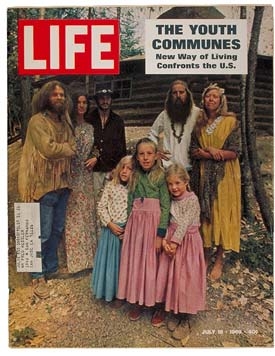
Awhile back I wrote about the advantages of older people living in small, close communities. In that earlier discussion (9-23-11) I quoted William Thomas as saying, “The Green House Project is a de-institutionalization effort designed to restore individuals to a home in the community by combining small homes with the full range of personal care and clinical services expected in high-quality nursing homes.” As a counterpoint to Thomas’ corporate business-model approach to creating small “nursing homes” instead of large ones, I offered the option of returning to the concept of the commune. In this notion older people would band together cooperatively to share resources, provide community, engage in fellowship, help each other to coordinate services and hire local help for daily needs. My notion was why let corporate America provide a community where in most of the rest of the world people create their own communities.

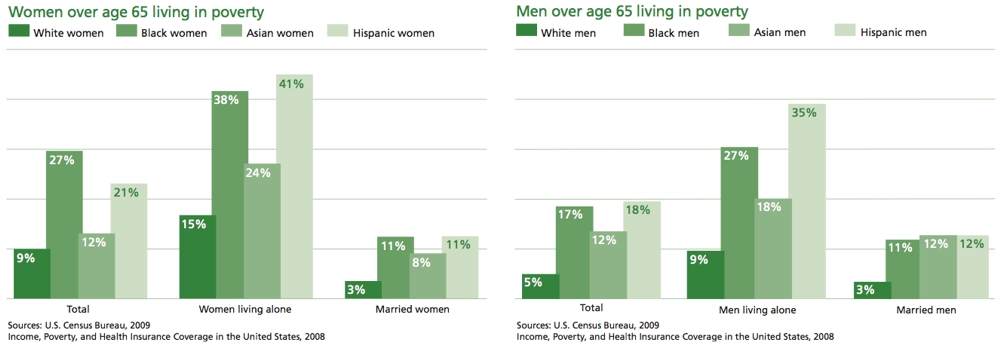
To add another dimension to the commune idea, Amanda Scarbrough sent me an article about poverty among elders. In this article the author, Deborah Carr (2010), says, “Poverty rates among older adults range from just 3.1 percent among white married men to an astounding 37.5 percent for black women who live alone and 40.5 percent for Hispanic women living alone. How can we make sense of the fact that overall elderly poverty levels have dropped precipitously over the past four decades, while some subgroups of older adults remain at great risk of impoverishment? She goes on to discuss the possible reasons for higher rates of poverty for single women, but there is an interesting observation to note from looking at two of the graphs she includes in her article. See below.

Looking at these two graphs it is true that the poorest group are women over 65 living alone. Notice that men over 65 are also fairly high in the poor category. The other interesting piece of information is both men and women who are married have quite low rates of poverty. This suggests that there is strength in numbers and that one should not live alone.

Moustgaard & Martilainen (2009) give us some information about an increase in cohabitation among the elderly, “Elderly cohabitation almost doubled between 1990 and 2003, with 3.4% of men and 2.1% of women currently cohabiting. Low educational attainment, low occupational social class, and living in rented housing were associated with cohabiting rather than being married.” This appears to support the notion of poorer people banding together to make ends meet.

Wondering about the subject of elder coops, I found an on-line discussion of this topic at a homestead forum. They seem to be talking about the very idea I have advocated.  The discussion is insightful. (http://forums.homestead.org/forum_posts.asp?TID=3129&title=elder-hippy-commune)

And so this adds another aspect to the notion of the elder commune and cooperative living situations. What we cannot do alone, we can do together.

———————————————————————-

References

Carr, Deborah. Golden Years? Poverty Among Older Americans. Contexts, American Sociological Association, Winter 2010. http://contexts.org/articles/winter-2010/golden-years-poverty-among-older-americans

Heta Moustgaard, Heta & Pekka Martikainen, Pekka. Nonmarital Cohabitation Among Older Finnish Men and Women: Socioeconomic Characteristics and Forms of Union Dissolution. The Journals of  Gerontology: Series B, 2009, volume 64B, issue 4, pp. 507-516. http://psychsocgerontology.oxfordjournals.org/content/64B/4/507.abstract


Hospice is a great idea. Developed in England over 50 years ago and a part of Medicare for the last 30 years, it has become an accepted part of end-of-life care. At first hospice was offered through non-profit services and mostly at home. Now a great deal of hospice care is offered by for profit corporations and in long term care facilities. The for-profit hospice services appear to have been “gaming the Medicare system” to maximize profits. The development of for profit businesses that exist to exploit aspects of Medicare and other insurance has a long history; remember in-patient youth psychiatric facilities in the 80’s and early 90’s? (Baughman, 1998; Gale Group, 2011)

Kenen (2011) discusses how the Department of Health and Human Services is seeking to cut back Medicare payments for hospice services. Hospice has grown into big business. Kenen states, “According to a June 2011 MedPAC report, the number of people getting Medicare hospice care doubled from 2000 to 2009, to more than 1 million, or about 40 percent of deaths. Total payments quadrupled, from less than $3 billion in 2000 to $12 billion in 2009. … Now, about half of hospices are for profit. Some are small, locally owned businesses, but much of the recent growth has been in big, publicly traded national chains, one of which is owned by the company once known as Roto-Rooter.”

Several strategies for reducing the costs have been suggested. Kenen says, “In 2009, MedPAC recommended that Congress scrap the standard payment rate, now about $151 per day, and replace it with a ‘U’ shaped scale. Hospices would get paid more at the beginning and at the end, when they typically provide the most hands-on care. In between, the daily rate would drop. Any hospice with a very high rate of long-stay patients would face additional regulatory scrutiny. A second approach, included in a recent MedPAC blueprint for offsetting Medicare doctor fees, would be to pay hospices a lower rate for nursing home care — 6 percent less, or about $3 billion in reductions over 10 years.”

Frankly these suggestions are rearranging the deck chairs on the Titanic. Health care policy in the US is rife with micro-management of services and costs that simply rearranges the status quo.

Why not rethink the whole thing? Go back to the beginning. Hospice was developed to meet a need in end-of-life care to back off from intensive interventions and to allow the dying person to approach death in a mindful and pain free manner. Was not the intent that hospice as a model for end-of-life care should become the regular and customary way any health care system helps dying people? In other words, get rid of hospice as an entity and simply make these well proved methods regular practice. All dying people would receive palliative care appropriate to their needs and their  care providers would know how this was done and arrange for it.

By eliminating  hospice as a specialized service and by stopping specific payments for providing it, we eliminate those niche for profit businesses that exploit Medicare. Hospice becomes not a “special activity” but a routine part of a person’s life. Seems simpler somehow. What’s wrong with this idea?

——————————————————————————————–

Baughman, Fred A. The Fraud of ADHD – Psychiatric History Repeating Itself. February 13, 1998. http://www.psychbusters.net/index.php?option=com_content&task=view&id=16&Itemid=28

The Gale Group, Inc. Psychiatric Hospitals: Industry Report. 2011. http://business.highbeam.com/industry-reports/business/psychiatric-hospitals

Kenen, Joanne. Medicare eyes hospice savings. October 17, 2011. http://www.politico.com/news/stories/1011/66177.html

Aging successfully appears on the surface to be pretty simple. Take for example the summary advice from years and years of interviewing older adults.

In an article dealing with the world’s most comprehensive and longest running longitudinal examination of human aging (it began in 1958), NIA’s Baltimore Longitudinal Study of Aging (BLSA) recommends the following for a long life: Be tobacco free, be physically active, eat a healthy diet, if you drink alcohol, drink only in moderation and have regular and appropriate health screenings. (Found at http://www.nia.nih.gov/HealthInformation/Publications/BLSA/02_what.htm. These recommendations also based on information provided by the Agency for Healthcare Research and Quality; based on research findings from the U.S. Department of Health & Human Services and the U.S. Preventive Services Task Force.)

These recommendations that are the essential distillation of over 50 years of research echo the words of a character from the 1937 film version of James Hilton‘s 1933 novel Lost Horizon, “To put it simply, I should say that our general belief was in moderation. We preach the virtue of avoiding excesses of every kind, even including the excess of virtue itself. … We rule with moderate strictness and in return we are satisfied with moderate obedience. As a result, our people are moderately honest and moderately chaste and somewhat more than moderately happy.” (http://www.dailyscript.com/scripts/Lost_Horizon.html)

In addition, the moderate folks of Shangri-La (The location of Lost Horizon) lived a very, very long time and did not look older than their early 20’s. They kept a young appearance all of their very long lives. Of course, if you left Shangri-La you quickly assumed the appearance of your age. One of the consequences of fantasy.

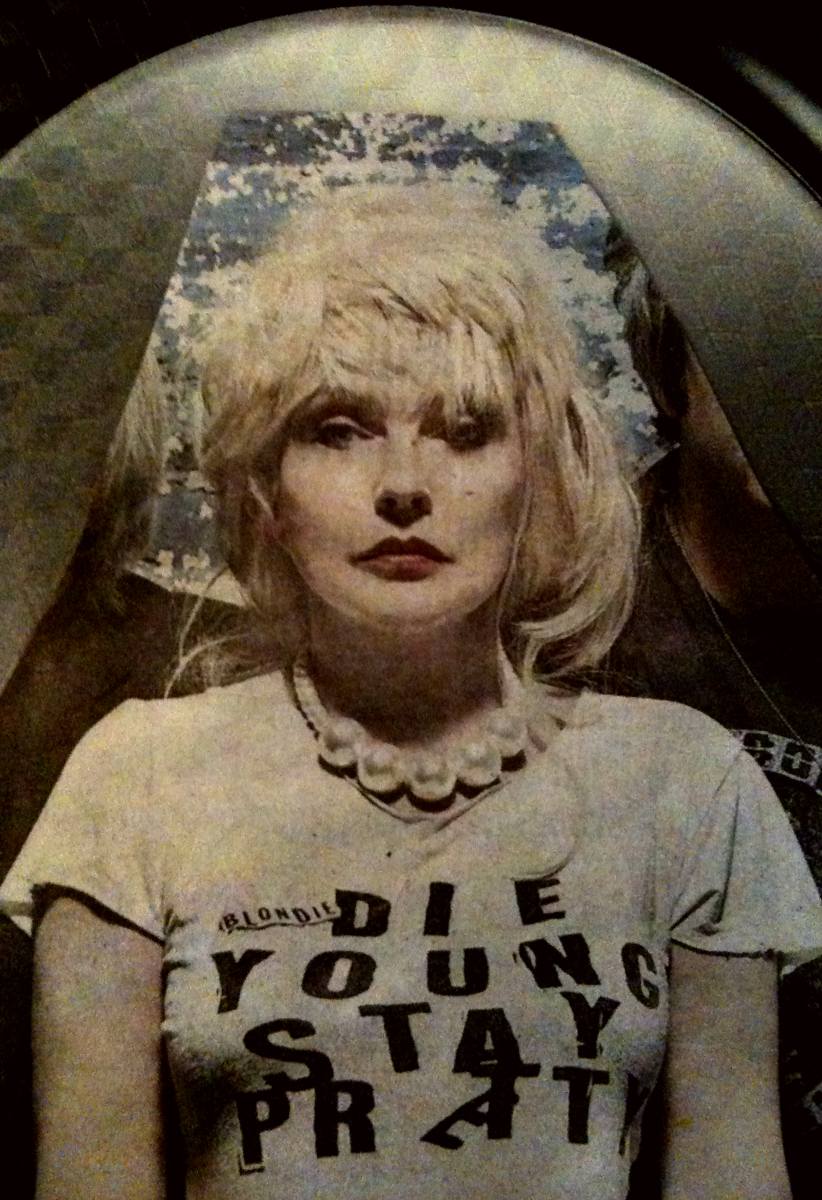
Debra Harry
Debra Harry of Blondie

In our world no matter how moderately successful is our aging, we tend to look our age and that comes with some social disadvantages. I saw a picture of Debra Harry, the lead singer from the group Blondie. Her shirt had a motto on it that encapsulates how we regard the prospect of aging, “Die young. Stay pretty.”

Where did we get the notion that youth, or some definition of beauty characterized by youth, was life’s’ desired state? The popular press supports the notion. Look at this title from a recent article: “What really stops ageing and why looking young is every woman’s holy grail?” (Frith-Powell, Helena. London Daily Mail, March 2008. http://www.dailymail.co.uk/femail/article-532630/What-really-stops-ageing-looking-young-womans-holy-grail.html#ixzz1anKkzYZU). And I would hypothesize that women are not the only gender caught up in agelessness.

Right, men too have lots of support in this quest. For example, a book, by Michael Lafavore, Men’s Health: Staying Young Looking Great (1997, Rodale Press). It’s not that people are not trying to counter this trend. Television shows (Today Show: Why Are We Obsessed With Looking Younger? Feb 9, 2011) and other media offer advice in this area. They stress the need to know your own self-worth, to realize your family still loves you, to seek inner beauty, etc. Still for all the talking the perception still stays; beauty lies in being thin, rich and young.

What’s in a role model? Last week we explored the possibility that older people could benefit their communities by sharing their wisdom and experience. Dianne, my wife, suggested a column about Miss Marple, a fictional character from British mystery fiction, as a role model of the elderly “wise woman.”

Jennifer Garner as Miss Marple?

“A good example from popular crime fiction is Agatha Christie’s Miss Marple who is, of course, an idealized image of the genteel spinster living quietly in a stereotypical English village. … On the level of the imaginary, Miss Marple reveals the possibility of a superior role for the wisdom of the older woman in modern society” (Hepworth, Mike. Stories of Ageing. Open University Press, Buckingham, England, 2000).

However, this endeavor was disrupted by the discovery that Walt Disney Studios “has closed a deal for a big screen reboot of Agatha Christie’s ‘Miss Marple’ mystery novel series, and the House of Mouse is making substantial changes to the story. Deadline reports that, instead of the British grandma Jane Marple portrayed in the books and in previous big screen incarnations, the film series will instead feature a young, far more svelte amateur sleuth, to be played by Jennifer Garner. (http://www.huffingtonpost.com/2011/03/29/miss-marple-jennifer-garner_n_841819.html)

OK, well that just shot down my intentions about “wise women” and instead raised the question of “How do we view people who are clever and wise?” It would seem that youth trumps all and since culture shapes our beliefs, there goes another brick in the wall to ignore the potentials of older people.Joan Hickson (born 1906) as Miss Marple

A last comment from Agatha Christie herself. “MGM cast Margaret Rutherford [who was 70 at the time] as Marple after it bought the rights in the late 50s. But Christie even disliked Rutherford’s interpretation of Marple. She complained in one letter: ‘Why don’t they just invent a new character? Then they can have their cheap fun and leave me and my creations alone.'” (http://mysteryreadersinc.blogspot.com/2011/03/miss-marple-disney-update.html)

Old age and retirement are often characterized as “being put out to pasture.” And while a cow probably likes an old age among the grasses and flowers, people tend to stagnate.  For example, one “elderly person said, ‘You see that piece of furniture over there? I’m like a piece of furniture.’ … Far from being glorified ottomans who send Christmas cards to their grandkids and burden their families financially, the elderly could use the free time of retirement to share their wisdom with the community at large and ultimately help change the world for the better” (Mackie, 2007).

I find this suggestion to be thought provoking on several levels.

Level one: I have a friend who, now retired from a career as a CFO, set up a small business to help other small business get started and running. He basically offers a combined accounting service plus business and financial advice. This is just part time and his fees are outrageously modest. He turns clients away to preserve his free time. This is a great example of keeping occupied in a meaningful way and sharing one’s lifetime of experience and knowledge.

Level two: My father, when at 80 he lost the ability to fix watches due to a stroke that deprived him of the use of a hand, took on a friend as an apprentice and shared his knowledge of watch repair. However, even though he almost naturally fell into this role of being a teacher, he was bitter and frustrated by his lost dexterity for the remainder of his life.

This is the quandary here. It is easy to say “let the elders of the tribe share their wisdom.” It is harder sometimes to transcend the other consequences of aging that leave us reduced in physical and mental facilities. It is this sort of quandary that makes me wonder about somehow stopping aging. Isn’t there a cream or something that will stop aging? I know I’ve seen those ads for it.

Anyhow, stopping the process of aging may be beyond medicine. Aging may be an unavoidable part of life. This final quote really got me thinking, “Instead [of prolonging life], the problem is the hubris inherent in the quest. People age for a reason, whether or not we understand that reason just yet.” (Gordon, 2009).

References:

Gordon, Bennett. Why People Age, and Why We Should. UTNE Reader, June 15, 2009. http://www.utne.com/Science-Technology/Why-People-Age-and-Why-We-Should.aspx

Mackie, Brendan. The Honor and Toil of Growing Old. UTNE Reader, October 4, 2007. http://www.utne.com/2007-10-01/The-Honor-and-Toil-of-Growing-Old.aspx

OK, I admit it, sometimes I’m touchy about people’s choice of words. In a blog post, William Thomas, founder of the “green house” movement that places elders in smaller group homes instead of traditional nursing homes, said, “Because of changing demographics, it’s necessary to rethink how elders are cared for.” (Diel, Stan. Elder care expert Dr. William Thomas: New approach needed for seniors. The Birmingham News, Sept. 7, 2011. http://blog.al.com/businessnews/2011/09/elder_care_expert_dr_william_t.html).

Picture from: http://beinecke.library.yale.edu/utopia/uc22.htmlI’m going to talk about all of the above statement but it’s the latter part that I find trying, the “how elders are cared for.” We care for people and animals that cannot care for themselves and for some of us that state does come in old age, but in general I find a loss of sensitivity to the fact that older people, who might look like they need caring for, actually are still sentient beings capable of having a lot of say in their own lives. We must always remain mindful of that fact.

Now the front half of Thomas’ statement refers to a good thing, a rethinking of housing options for older people. Last week I explored multigenerational living arrangements. This week we’ll look at some alternatives to the dreaded “Nursing Home.”

The Green House Project, founded by Thomas, “is a de-institutionalization effort designed to restore individuals to a home in the community by combining small homes with the full range of personal care and clinical services expected in high-quality nursing homes.” (Green House Project web site – http://thegreenhouseproject.org). This organization works helps other organizations to build and operate these communal homes for elders. An example of one such partner is St. Martin’s in the Pines who have a new facility called Cottages at St. Martin’s (http://www.stmartins.ws/communities-and-services/the-cottages).

This seems like a great idea. They are small communities of people who get to know each other and have access to professional health care services as needed. Very cool and a definite step up from “The Home.”

So, this gave me an idea. Harking back to the 60’s and the hippy commune movement (Where’s my old copy of the Whole Earth Catalog?), why not encourage people as they grow older to form into cooperatives and build communes?  Everyone could buy into the coop and there would be private living quarters plus common areas for social gatherings and recreation. The coop could even develop business activities. Who says old people just have to play Parcheesi and watch TV. The coop would have some form of on-site staff for daily needs and access to other health care professionals who would come to site as needed.

This would require some planning, but today’s emerging elders are the Baby Boomer generation and they have smarts and capital, so such a coop to provide for one’s later years would be easy to put together.  So, as we age towards the Age of Aquarius, let’s gather up our love beads and a copy of the Whole Earth Catalog and head out into the hills to build a commune for the last days of our lives.

When I think of multigenerational families, what comes to mind is the image of Big Daddy and his family from Tennessee Williams’ play Cat on a Hot Tin Roof. Now not all multigenerational families are dysfunctional (ignoring images from All in the Family now). It used to be very common in the US. In many cultures, other than the US, multigenerational families are the norm. I am reminded of homes I visited in Kuwait that were huge with many living areas for several generations of family members.

Big Daddy and his extended family

It seems to be there are three options in the US for living quarters as we age.

  • Live alone or with a spouse, sibling or a friend/peer.
  • Live with relatives from another generation.
  • Live in some form of institution, nursing home, assisted living, whatever but a place that has paid staff to help out. Options 1 and 2 can be augmented by paid staff too but let’s just focus on location not arrangements.

The trend has been to avoid institutional living until that’s the only option. However, are people choosing multigenerational settings over living alone?  Philip Cohen, professor of sociology at the University of North Carolina, said, “We’ve seen for a long time that people tend to live in multi-generational households when they don’t have as much choice as they’d like. So it seems like Americans, when they can afford to, don’t do this. So when we see a strong uptick in multi-generational living, we have to expect that it’s economic. Although frankly, the numbers have been trending up since the middle of the decade. … Well the long term decline in multi-generational living made us think that it would never turn around. The steep increase in the last few years has us wondering. I don’t know.” (Marketplace Morning Report. Multigenerational Home Numbers on the Rise. Published: August 30, 2011.)

Certainly, the institutional option has it’s risks and the trend to keep disabled people in their homes while providing home-based services has it’s downside as well. Commenting on the quality of New York’s record in providing long-term care for its residents, an editorial stated, “The state ranked 44th in the percentage of high-risk nursing home patients who develop bed sores, which is often a measure of neglectful care. It ranked 50th in the percentage of home health patients and 28th in the percentage of nursing home patients who were sent to the hospital [another indicator]. … It also ranked 50th in the percentage of disabled adults living in the community who always or usually get the support they need. This is an ominous statistic given the drive to move larger numbers of people out of institutions and into community-based care.” (New York Times Editorial. Bad Grades on Long-Term Care. Published: September 12, 2011. Note: sometimes this link takes one to a log in page – I do not know why or the solution.)

In reviewing blogs discussing the ins and outs of maintaining multigenerational homes, many of the posts dealt with healthy participants. One post did comment on the converse.  This is from Rockville Mama, “Parents eventually get old and frail and sick. Then what? There’s no ’sharing’: you look after them like they looked after you when you were little, it is really hard and there’s very few options for help for people in this situation in this country. You should talk to people (especially women) who have had to quit jobs to be able to look after both their kids and their sick parent/s. So the issue is not just how to I manage the ’space’, the chores and the personal conflicts. I do think though, despite all the challenges, this is the best system there is for people of all age to have a supportive family life. It requires a lot of give and take: which it seems like people now simply do not want to be bothered with.”  (New Your Times. Tips for Multigenerational Households. Posted: December 8, 2008)

We never know what will happen in life. Insurance agents are always trying to sell you a policy that will protect your interests in the future, but often we are reluctant to purchase, saying to ourselves, “That won’t happen.”  Then, sometimes it does.

Air quality is sort of like that. We breathe air every day and it’s fine, right? Below is the forecast for the air quality across the US for today (9-9-11). Our area of Texas is the red spot down at the bottom.

Air Quality Index Forecast_for_9-9-2011

Air Quality Index Forecast_for_9-9-2011

We needed to buy that insurance policy.

Now, a lot of that red is due to smoke from the huge wildfires currently burning in central Texas. While we all love to smell a campfire in the autumn, the fine particles in wood smoke can be bad for you. The AirNow web site says, “If you are healthy, you’re usually not at a major risk from smoke. The biggest health threat from smoke comes from fine particles. These microscopic particles can get into your eyes and respiratory system, where they can cause health problems such as burning eyes, runny nose, and illnesses such as bronchitis. Fine particles also can aggravate chronic heart and lung diseases. Older adults are more likely to be affected by smoke, possibly because they are more likely to have heart or lung diseases.” (http://airnow.gov/index.cfm?action=smoke.page1)

So, all this smoke is making the air quality worse and even at times, like maybe today, unhealthy. The curious thing comes back to that insurance policy. What sort of insurance policy do we have for the air? Since controlling when wildfires occur is a bit difficult, perhaps the best insurance is clean air to start with, then when you add some smoke it’s not so bad. Funny, the EPA (and other government agencies) has just reduced the requirements for clean air. Some links commenting on these decisions and recommendations:

Health is a very complex issue and an individual can only be so mindful of their own health practices. Our larger society and the decisions made by those larger groups affect us all. The recent wildfires have shown one aspect of how our future is impacted by how mindful we are in the present moment.

At one time, my son Morgan lived in Florida while I lived in Texas. Once we met halfway in New Orleans to hang out for a few days. We were wandering the French Quarter looking for dinner. Now finding the right place to eat is always a long process for he and I. It’s not that we disagree on what we like. We agree quite well. The trick is finding a place that meets our standards and expectations. Down at one end of the quarter we saw Jimmy Buffett’s Margaritaville Café. We checked it out and both decided it was not where we wanted to go*.

This mutual understanding is analogous to another related term from a letter by Debra Canova where she coins the term geezerville in referring to living facilities restricted to older people. She makes three points that I really like. First, Canova says, “I do not agree with segregating retired people into geezer-ville communities,” second, “Older people should be in the mix of our general population to con¬tinue to lead useful and rich lives,” and third, “As a baby boomer, geezer-ville is not a place I would even consider.”

I don’t think either Morgan (an X-Gen’er) nor I (a slightly pre-baby boomer) would ever consider geezerville either. Oh, and I know my father and three aunts (all living into their 90’s) rejected geezerville as well.

So why move to geezerville? In an article by Steve Gurney discussing age segregation, he says, “most people I talk to state that the move [to an age segregated community] was to receive services, downsized lifestyle and not to get away from younger people. … I feel like our current system presents the ‘easy’ option, pay your rent here and we will deliver these services.”

It is curious that the services older people need are the same services needed by people of any age who are frail, have balance problems, brittle bones, coordination issues, processing difficulties, mood swings, memory lapses, etc. Anyone can be in need of services but we create isolated communities for people who are old.

As a counterpoint, we also create residential schools for young people with these same and similar issues and the occasional mental facility for the rest of us. Speaking of residential mental facilities; those are somewhat gone now with the concepts of deinstitutionalization and mainstreaming having integrated many inmates into the general population. Not sure how that fits in here, but perhaps it highlights the difficulty of regulating human interactions and living patterns.

At one time, Morgan lived in Florida and Jason lived in California. Now, Dianne and I celebrate that both sons live within a hoot ‘n a holler of our rural home in the Texas Hill Country. Life is complicated and as time moves along we are presented with different paths to take. Spare me the Road to Geezerville (with apologies to Bob Hope, Bing Crosby and Dorothy Lamour)

Poster - Road to Singapore

Poster - Road to Singapore

References and Links

Buffett, Jimmy.  Link to the Margaritaville Café in New Orleans – http://www.margaritavilleneworleans.com

Canova, Debra. Fewer ‘geezer-ville’ communities needed. Letter at – http://www.ongo.com/v/813460/-1/80AB69EBA8D8B667/letter-fewer-geezer-ville-communities-needed

Gurney, Steve. Some Thoughts on Age Segregation. Blog posting at – http://www.retirement-living.com/publisher/some-thoughts-on-age-segregation

Paramount Pictures. Poster for 1940 film “Road to Singapore” – http://en.wikipedia.org/wiki/File:RoadToSingapore_1940.jpg

* Not to drag this story out, but we finally chose a brew pub and ribs joint down by the old Jax brewery.

OK, sometimes free association produces some strange connections. Today we are talking about snuggly little robots who are programmed to be companions to patients with dementia.  My first thought however was of RoboCop, the non-snuggly robot programmed to fight crime. At first it seems an odd connection, but RoboCop was designed to do what humans could not. His job was to protect and serve the citizens of his city. He was to do this all the time, 24 hours a day, at a level humans could not sustain. (RoboCop, 1987, http://www.imdb.com/title/tt0093870).

Caring for patients with dementia is a 24 hours a day job too. All too often humans serving in this role reach a point of fatigue and failure just like the human police force in RoboCop did.

A recent article in The New York Times discusses the companion robot, Paro. Paro is a soft, stuffed toy-like robot that looks like a baby seal; all furry and really cute. It was designed as a companion for people who need a friend (http://www.nytimes.com/2010/07/05/science/05robot.html).

Thus, using a small, snuggly robot like Paro to keep dementia patients calm and occupied seems a really cool idea. The NYT article goes on to say, “Their appearances in nursing homes, schools and the occasional living room are adding fuel to science fiction fantasies of machines that people can relate to as well as rely on. And they are adding a personal dimension to a debate over what human responsibilities machines should, and should not, be allowed to undertake. … But some social critics see the use of robots with such patients as a sign of the low status of the elderly, especially those with dementia. As the technology improves, argues Sherry Turkle, a psychologist and professor at the Massachusetts Institute of Technology, it will only grow more tempting to substitute Paro and its ilk for a family member, friend — or actual pet — in an ever-widening number of situations.”

Pets (I recommend cats as the lowest maintenance form) are wonderful companions. There are limitations however, and it’s not the feeding and cat box cleaning either, it’s that they are independent creatures. In the evening, I’ll get one of two of our four cats to sleep on my lap, if I stay still enough. The others are happy just to sack out nearby. But in the morning, after the little female, Grace, hassles me into filling the food bowl, she is the shill for the group, err… make that pride, all the cats go off and do their own thing. I’m here writing and they are wandering about, sleeping,  playing, hunting, whatever, but they are not, repeat not, providing companionship.

Back to the NYT article., “Marleen Dean … was not easily won over. When the home bought six Paro seals with a grant from a local government this year, she thought, ‘what are they doing, paying $6,000 for a toy that I could get at a thrift store for $2?’ she said.  So she did her own test, giving residents who had responded to Paro a teddy bear with the same white fur and eyes that also opened and closed. ‘No reaction at all,’ she reported. … ‘It’s something about how it shimmies and opens its eyes when they talk to it,’ Ms. Dean said, still somewhat mystified. ‘It seems like it’s responding to them.’ … Yet several patients whose mental faculties are entirely intact have made special visits … to see the robotic harp seal. ‘I know that this isn’t an animal,’ said Pierre Carter, 62, smiling down at the robot he calls Fluffy. ‘But it brings out natural feelings.’ ”

So, a robot has infinite patience and will be a happy companion as long as the battery is charged. When the battery is drained it will seem to be asleep, but still in your arms and happy. The need to give and receive companionship and nurturing reminds me of the ending of John Steinbeck’s novel The Grapes of Wrath. “The novel concludes or simply stops with Rose of Sharon breastfeeding a starving stranger. The last sentence reads: ‘She looked up and across the barn, and her lips came together and smiled mysteriously.’ … Barbara Heavilin notes, ‘It also leaves a powerful closing image of human compassion — giving what little one has to save another’” http://cornellreading.typepad.com/grapes_of_wrath/2009/08/chapter-30-the-ending.html).

Image from Seen and Heard International Opera Review (http://www.musicweb-international.com/SandH/2007/Jan-Jun07/wrath1702.htm)