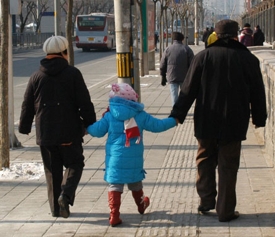
 Here’s another topic about which I know little: being a grandparent. Neither of my two sons has ever married or become a father. As a consequence, I have no experience with re-visiting the raising of children as an indulgent spectator, which is the role I assume most grandparents fulfill. Many of my retired friends seem to have focused their lives on grandchildren. I guess that’s a good thing.
Actually my notion of grandparenting is a stereotype. Grandparents take on many active and important roles in helping their children to raise their children. Often even becoming the only parent a child has.
I wondered if the role of grandparent has changed over the years. I could not really find any information on the role of grandparents changing over time. I’d hazard a guess that we are more indulgent and spend more on grandchildren than in earlier times, but change data was a bit thin. The role of back-up parent seems to have always been the role. The age of grandparents is a variable over time.
These days, the average age of becoming a grandparent is about 47 (1) and the average age of grandparents in general is 64 (2). Also, there are about 70 million grandparents in the US (3). Back a few hundred years there were not so many grandparents, they tended to be younger and even still in their own childbearing/rearing processes (4). However, the trend in childbearing is changing and current generations are having children later in life and this means the role of grandparent may not become available so early in the future (5).
So, maybe there is hope for me still.
References
- Graham, B. ‘Grandma gets a Reboot. AARP Bulletin, September 2014, 55, 7, 10-12.
- AARP. The Grandparent Study 2002 Report. AARP, May 2002.
http://assets.aarp.org/rgcenter/general/gp_2002.pdf - Grandparent Statistics. Statistic Brain.
http://www.statisticbrain.com/grandparent-statistics - Grandparents. Encyclopedia of Children and Childhood in History and Society.
http://www.faqs.org/childhood/Fa-Gr/Grandparents.html - Tergesen, A. The Long (Long) Wait to Be a Grandparent. Wall Street Journal, March 30, 2014.
http://online.wsj.com/news/articles/SB10001424052702303775504579395501172676002
Some miscellaneous Links:
- Francese, P. The MetLife Report on American Grandparents. MetLife Mature Market Institute®, July 2011.
https://www.metlife.com/assets/cao/mmi/publications/studies/2011/mmi-american-grandparents.pdf - Fun facts about grandparenting.
http://www.grandparents.com/food-and-leisure/did-you-know/surprising-facts-about-grandparents - Source for everything about America, statistics-wise anyhow.
U.S Census Bureau, American Community Survey.
http://www.census.gov/acs/www
Image Source: http://www.publicdomainpictures.net
Join us for a real-time discussion about questions raised by this essay on Tuesday from 12:00 p.m. to 12:45 p.m. We use the self-same virtual world as was mentioned above. See Discussion and SL tabs above for details. Link to the virtual meeting room: http://tinyurl.com/cjfx9ag.

 As I progress in life I have occasion to visit new and different health care providers. Every one of them gives me a six to eight page form requesting information. It’s the same information every time. It may be formatted differently but it’s still the same information: name, DOB, address, insurance, past history, ROS, permissions, etc.
 Summers can be hot! I remember really hot Summers when I was a teen in Oakland, California. Summers there are often cool but I remember some Summers that were very, very hot. I’d awaken in the morning and the sun would be bright and the air screamed, “Heat is coming!” My Mother, on those days, would draw all the blinds to keep inside what coolness the night had imparted and in the afternoons we would huddle around our little fan waiting for sundown to bring relief.
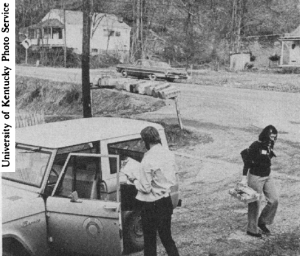 In 1975, I joined a team of educators at the University of Kentucky who were engaged in a very unique form of health science education (See Connelly, Assell & Peck below for further details). We gathered students from across the spectrum of health professions and, along with a faculty member as sponsor, had them live in a rural, Kentucky town during the month of January. Hence the name of the experience: Kentucky January.
 Halley’s Comet swings by our part of the solar system every 76 years or so. People have observed it since about 240 BCE. Sometimes when it returns the comet is the brightest thing in the sky and people have often associated it with prophecy or saw it as an omen of import.
 On the Fourth of July one does think about the men who signed the Declaration of Independance back in 1776. When I think of them I imagine those paintings of guys in white wigs standing around in heavy clothes on a hot, sweltering day in Philidalphia. I assume those images are of old people. They all have white hair, so they are old, right? Wrong.
 Have you ever had to make a decision for someone you love that will impact the remainder of their life? If not, chances are good that you will be asked to do so at some point. To make things more interesting, this task often occurs during an already stressful period. Wondering what I am talking about? Let me provide you with an example.
 When I’m trying to think of a topic for my blog, I start researching by perusing the AARP website at
 Someone very close to us has lived in a worsening state of dementia for more than 10 years. She is still able to live independently, a blessing in itself, but the question in everyone’s mind is, “how long until constant care will be needed?” Recently, we addressed a major issue. The result has halted, and at times, seemed to have reversed the state of her dementia. It’s been such a miracle that I want to share it with you.
 There seems to be a blurred line between “getting old” and early warning signs of dementia or Alzheimer’s. When does forgetting a word more often become a “problem” or a warning sign of more profound changes? At the Alzheimer’s Association, we have a list of “10 Warning Signs” that we use as a guide to see if a visit to a physician may be needed (for more information, visit
  There are coincidences, accidents, happenstance and serendipity but I wonder if those curious, unanticipated incidences just happen for no reason at all. Allow me to share a few thoughts.
 I find that it is common to plan for things such as retirement from a financial support perspective. We even prepare for our “final days” such as securing retirement homes, funeral plans, burial plots, and advanced directives. However, how often do we think about planning moderate exercise routines, joining new social groups, downsizing the square footage of our yards and homes to match our physical abilities? When and how will we decide we should no longer drive or give up certain foods?
 Rodger Marion