
Marcos Caliente – An enchanted chili created by Marvin Niebuhr, who is one of those isolated, rural artists with an eye on the inner spaces
I’m burrowing through the August 2013 issue of Texas Monthly thinking about writers.
Earlier this week I read in the newspaper about John Graves moving on at 92. Graves lived in Glen Rose and was a well known writer about Texas rural life. His Goodbye to a River is considered a classic and his other books, for example: Hard Scrabble: Observations on a Patch of Land and From a Limestone Ledge, leave a legacy of insightful observations about Texas, conservation and nature.
Benjamin Sáenz is another Texas writer and poet from a later generation. He’s almost 59, a professor at UTEP and lives in El Paso. He writes about growing up in West Texas and New Mexico but mostly he writes about growing up inside, the process whereby we learn about ourselves.
Artists (writers and poets and painters and anyone else who goes off alone to explore) put into expression (words, pictures) what we all experience but often cannot quite grasp. It is the artist who while questing through his own awareness often sees those insights that we all know lie at the root of our behavior and dreams.
The cool thing about this process is that it is a skill that stays with artists all their lives. And while Ludwig van Beethoven wrote wonderful music when he was deaf, for most of us staying creative is linked to staying healthy. As providers of health services, we can make a contribution to art too. When we work to create efficient, coordinated health services for all people, especially isolated, rural folks, we add to our library of human understanding by enabling people to have the energy and freedom to look inside and tell us what they find there.
Join us for a real-time discussion about ideas raised by this essay on Wednesday from 12:00 p.m. to 12:45 p.m. See Discussion and SL tabs above for details. Link to the virtual meeting room: http://tinyurl.com/cjfx9ag
References
Balli, C. The Passion of Benjamin Sáenz. Texas Monthly, August 2013. http://www.texasmonthly.com/story/the-messy-visionary-passionate-life-of-benjamin-s%C3%A1enz (This is not the whole article but just a stub to serve as a source).
Holley, J. Goodbye to a writer; John Graves dead at 92. Houston Chronicle, August 2, 2013. http://www.chron.com/news/houston-texas/houston/article/Goodbye-to-a-writer-John-Graves-dead-at-92-4698127.php
Image Source: http://flimflamlab.blogspot.com/2009/10/marcos-returns.html

 Everyone tells you that you need to have a will. That way both your relatives and the courts will know what you wanted done with all your stuff. As we get older the need for a will usually becomes fairly obvious and it’s a good wellness behavior to “get one’s affairs in order.”
 Do your patients get the most out of the internet when it comes to caring for themselves? Let’s talk about how YOU can direct them to useful websites so they don’t get swallowed in a Google of information.
 We had a number of guests to dinner for the Fourth of July celebration yesterday. One of our guests, an older, retired man, had had a lung transplant. He reported how well his new lungs worked and how marvelous it was that medicine could give him such a new lease on life.
 At the two year mark of this experiment in social media (our blog, Facebook, web site, virtual discussion), I want to divert from talking about the rural elderly and muse a bit about information technology.
 Things in life come in trends. Rarely is a particular thing in our lives a singular or unique event. Take for example my leather jacket. I bought this jacket over twenty years ago and at the time considered it to be a unique find. As I was wearing it that first Winter I saw many, many very similar leather jackets. From this I concluded that we do not have unique thoughts but are shaped by the zeitgeist of our times.

 Most Texans are aware and probably proud that the Texas Department of Criminal Justice (TDCJ), which houses Texan prisoners, is large. Very large! Texas is second to only California in the size of its prison system with 156,526 in the TDCJ facilities. Also, as it does every year, according to the Death Penalty Information Center, Texas led the nation in 2012 with 15 executions.
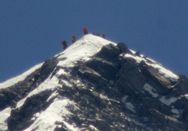 “An 80-year-old Japanese man who began the year with his fourth heart operation became the oldest conqueror of Mount Everest on Thursday, a feat he called ‘the world’s best feeling’ even with an 81-year-old Nepalese climber not far behind him. Yuichiro Miura, a former extreme skier who also climbed the 8,850-meter (29,035-foot) peak when he was 70 and 75, reached the summit at 9:05 a.m. local time, according to a Nepalese mountaineering official and Miura’s Tokyo-based support team.” (Gurubacharya, 2013)
 How many people do you know who routinely take more than one medication? More than two? Now, look in your own medicine cabinet and read the labels. How many medications do you have that each contains acetaminophen or ibuprofen? Taking multiple medications and multiple medications containing the same ingredients are two examples of polypharmacy.
 I recently came across an article on “6 predictions for our digital future” written by CNN’s Doug Gross. It outlined the predictions made by Google chairman, Eric Schmidt, in a new book “The New Digital Age: Reshaping the Future of People, Nations and Business,” The article and book centered on what the “world will be like when everyone on Earth is connected digitally.” It is Mr. Schmidt’s belief that this will happen by the end of the current decade.
 Last month I was at the Annual Herbal Forum at Round Top. This is a gathering of people, from across Texas, who grow and use herbs in cooking and for health benefits. I use herbs in cooking but there is a very long tradition for the beneficial uses of herbs for curing aliments, preventing illness and maintaining wellness. I’m going to spend an occasional week, here and there, on exploring an herb or two as they relate to the rural elderly.
 Do you have experience with diagnostic error? Have you ever brought your car or computer to be fixed and you get it back and it seems like the problem starts happening again after a few days? You have probably encountered diagnostic error with numerous patients and you (and they) may have never known. Diagnostic error can include over-diagnosis, misdiagnosis, missed diagnosis, or severely delayed diagnosis.
 Upon admission to hospital Mrs. Murphy, age 81, lays down comfortable in bed and is reluctant to get up. “I am in the hospital because I am ill and I need to stay in bed and be cared for,” she says. “I need to rest and regain my strength and get well.”

 Rodger Marion
