I’ve been reading a biography of Orson Wells (1) as I move through the editing process for my own feature film (2). Wells was and still is considered a genius at filmmaking. His career in films was marked by nearly constant struggle with the people financing his films. At the end of his life he was very unhappy about how it all worked out for him.
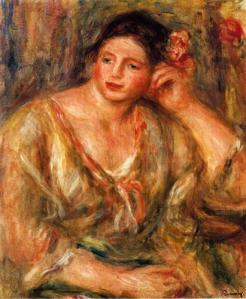 Yesterday I was at the McNey Art Museum in San Antonio and saw a wonderful landscape by Pierre-Auguste Renoir. At the end of his life Renoir suffered from terrible rheumatoid arthritis and then was confined to a wheelchair due to a stroke (3). Even up to the end he continued to paint outdoors. His assistants carried him and handed his brush to him, as picking them up was difficult due to the rheumatism. He died in 1919 and retained his mastery of painting until the end. The image here is of one of these last paintings done in 1918.
It was the parallels of these two lives that struck me. Both were creative geniuses and widely acknowledged as such by the world. Both men were working at their crafts all their lives. One however was successful and, apparently happy, throughout his life. While the other experienced stress and frustration.
We say that one component of aging well is to stay busy. I content that being busy is not enough. One needs to foster the energy that comes from creative endeavors. I think it’s the creative fire that feeds the soul.
So, why was one man unhappy and the other content? We might look to their past for issues and phobias. Better however I think to look at the decisions made moment-by-moment. No matter how hard we always have a choice and we can always chose again. Nothing extends beyond now. Each man chose and got his choice.
“Wells refused to accept ‘that genus disappears with old age… Fitzgerald [like Hemingway]… was rotted with the same anguish. That attitude is death.” It was that process of creation that kept Wells alive and kicking (1, p. 353).”
I just don’t think he was very happy about it.
References
- Heylin, C. (2005). Despite the System: Orson Wells Versus the Hollywood Studios. Canongate Books, Ltd., Edinburg, Scotland.
- Nudged. (2014). The Nudgedmovie.com website. Retrieved 07:32, Oct 03, 2014, from http://nudgedmovie.com.
- Pierre-Auguste Renoir. (2014). The Biography.com website. Retrieved 07:32, Oct 03, 2014, from http://www.biography.com/people/pierre-auguste-renoir-20693609.
Image Source: WikiArt: Visual Art Encyclopedia. (2014). Madeleine Leaning on Her Elbow with Flowers in Her Hair (1918) by Pierre-Auguste Renoir. Retrieved 07:32, Oct 03, 2014, from http://www.wikiart.org/en/pierre-auguste-renoir/madeleine-leaning-on-her-elbow-with-flowers-in-her-hair-1918.
Join us for a real-time discussion about questions raised by this essay on Tuesday from 12:00 p.m. to 12:45 p.m. We use the self-same virtual world as was mentioned above. See Discussion and SL tabs above for details. Link to the virtual meeting room: http://tinyurl.com/cjfx9ag.
 Here’s another topic about which I know little: being a grandparent. Neither of my two sons has ever married or become a father. As a consequence, I have no experience with re-visiting the raising of children as an indulgent spectator, which is the role I assume most grandparents fulfill. Many of my retired friends seem to have focused their lives on grandchildren. I guess that’s a good thing.
 As I progress in life I have occasion to visit new and different health care providers. Every one of them gives me a six to eight page form requesting information. It’s the same information every time. It may be formatted differently but it’s still the same information: name, DOB, address, insurance, past history, ROS, permissions, etc.
 Summers can be hot! I remember really hot Summers when I was a teen in Oakland, California. Summers there are often cool but I remember some Summers that were very, very hot. I’d awaken in the morning and the sun would be bright and the air screamed, “Heat is coming!” My Mother, on those days, would draw all the blinds to keep inside what coolness the night had imparted and in the afternoons we would huddle around our little fan waiting for sundown to bring relief.
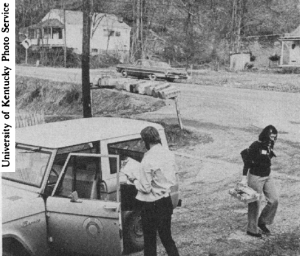 In 1975, I joined a team of educators at the University of Kentucky who were engaged in a very unique form of health science education (See Connelly, Assell & Peck below for further details). We gathered students from across the spectrum of health professions and, along with a faculty member as sponsor, had them live in a rural, Kentucky town during the month of January. Hence the name of the experience: Kentucky January.
 Halley’s Comet swings by our part of the solar system every 76 years or so. People have observed it since about 240 BCE. Sometimes when it returns the comet is the brightest thing in the sky and people have often associated it with prophecy or saw it as an omen of import.
 On the Fourth of July one does think about the men who signed the Declaration of Independance back in 1776. When I think of them I imagine those paintings of guys in white wigs standing around in heavy clothes on a hot, sweltering day in Philidalphia. I assume those images are of old people. They all have white hair, so they are old, right? Wrong.
 Have you ever had to make a decision for someone you love that will impact the remainder of their life? If not, chances are good that you will be asked to do so at some point. To make things more interesting, this task often occurs during an already stressful period. Wondering what I am talking about? Let me provide you with an example.
 When I’m trying to think of a topic for my blog, I start researching by perusing the AARP website at
 Someone very close to us has lived in a worsening state of dementia for more than 10 years. She is still able to live independently, a blessing in itself, but the question in everyone’s mind is, “how long until constant care will be needed?” Recently, we addressed a major issue. The result has halted, and at times, seemed to have reversed the state of her dementia. It’s been such a miracle that I want to share it with you.
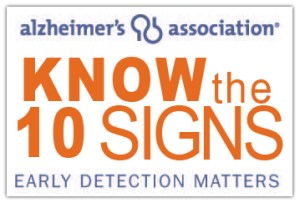 There seems to be a blurred line between “getting old” and early warning signs of dementia or Alzheimer’s. When does forgetting a word more often become a “problem” or a warning sign of more profound changes? At the Alzheimer’s Association, we have a list of “10 Warning Signs” that we use as a guide to see if a visit to a physician may be needed (for more information, visit
  There are coincidences, accidents, happenstance and serendipity but I wonder if those curious, unanticipated incidences just happen for no reason at all. Allow me to share a few thoughts.
 Rodger Marion